
Zum Inhalt springen Zur Suche springen

Unsere Forschung

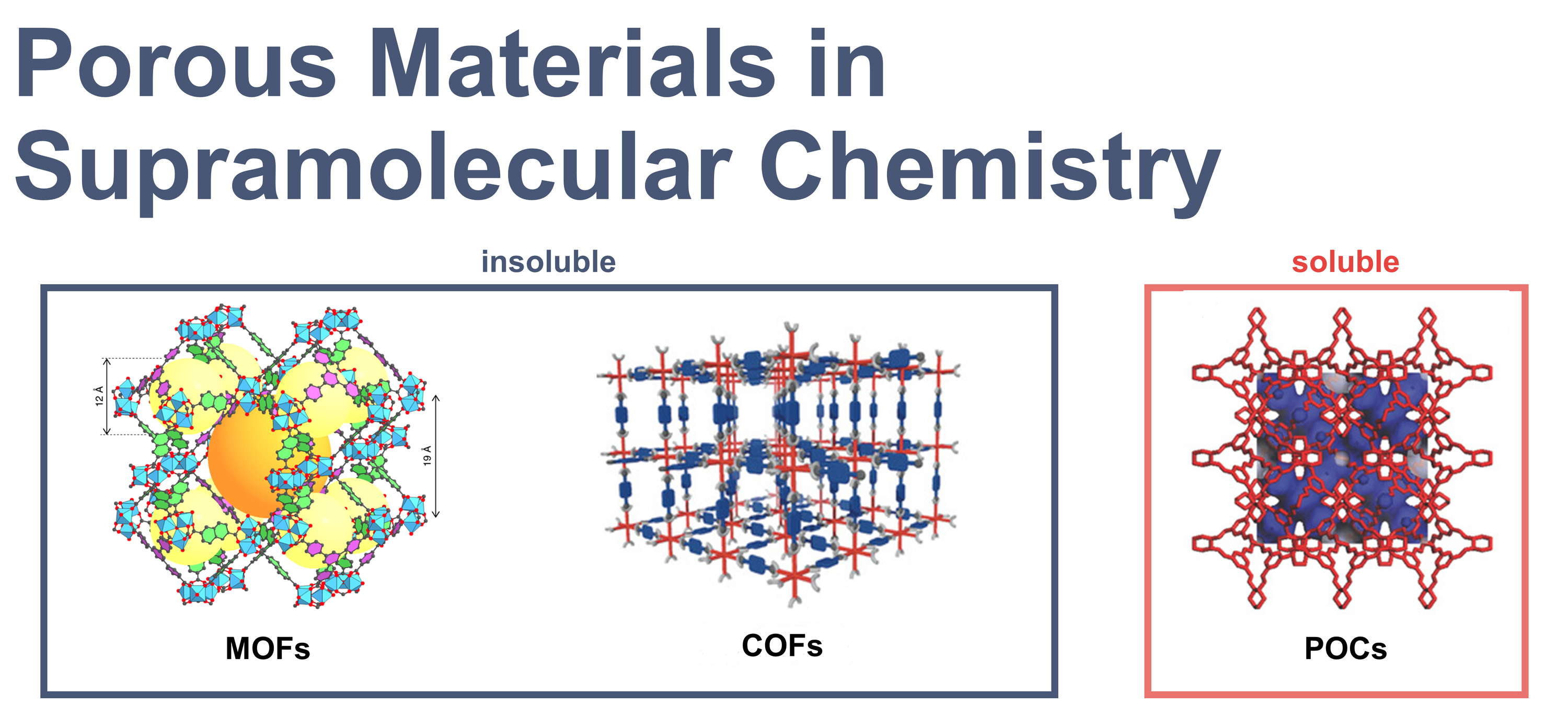
Our research is driven by the creative challenge of designing, synthesising, and assembling functional supramolecular architectures and materials that transcend the properties of individual molecules. 

Work in our laboratories begins with the organic synthesis of tailored building blocks, ligands, and host systems, providing precise molecular control as the foundation for higher-order assembly. These systems are subsequently investigated with respect to their structural, physicochemical, and functional properties, with particular emphasis on applications as advanced functional materials. A central focus of our current research is the development of responsive supramolecular systems that adapt to changes in their environment, thereby enabling external control over structure and function and opening pathways toward adaptive and sustainable material concepts.

Our research is embedded in a strong collaborative environment. Internally, and externally, we work closely with complementary research groups across chemistry and materials science, enabling access to a broad range of expertise, instrumentation, and perspectives.

The intellectual life of the BMSchmidt group is structured around weekly group meetings held on Mondays. Several meeting formats are run in rotation, including regular research updates, introductory presentations, a paper club, WRIST sessions, and trip reports. During research updates and introductory talks, group members present recent results and ongoing projects, fostering constructive scientific discussion and feedback. The paper club focuses on the critical discussion of a current publication from the recent literature, strengthening analytical and presentation skills. Conference trip reports provide an opportunity for members who did not attend a meeting or conference to benefit from shared insights and scientific highlights. WRIST, short for Writing, Reading, and Studying, is an optional format designed to support focused progress on tasks that have been procrastinated on, offering a structured and quiet environment for productive individual work alongside other group members.

General Techniques and methods that you can learn in our group: 

Modern synthetic (metal-)organic chemistry: Students gain extensive training in contemporary organic, polymer, and metal–organic synthesis, with a strong focus on aromatic and functional molecular systems. This includes standard purification techniques such as column chromatography and comprehensive compound characterisation using 1H-, 13C-, and 19F-NMR spectroscopy, as well as mass spectrometry (ASAP, ESI, EI, and MALDI).

Supramolecular chemistry: We explore chemistry beyond the covalent bond, with emphasis on host–guest interactions, molecular recognition, and self-assembly processes. Supramolecular systems are analysed using advanced NMR techniques (e.g., DOSY-NMR and titration experiments) and single-crystal X-ray diffraction.

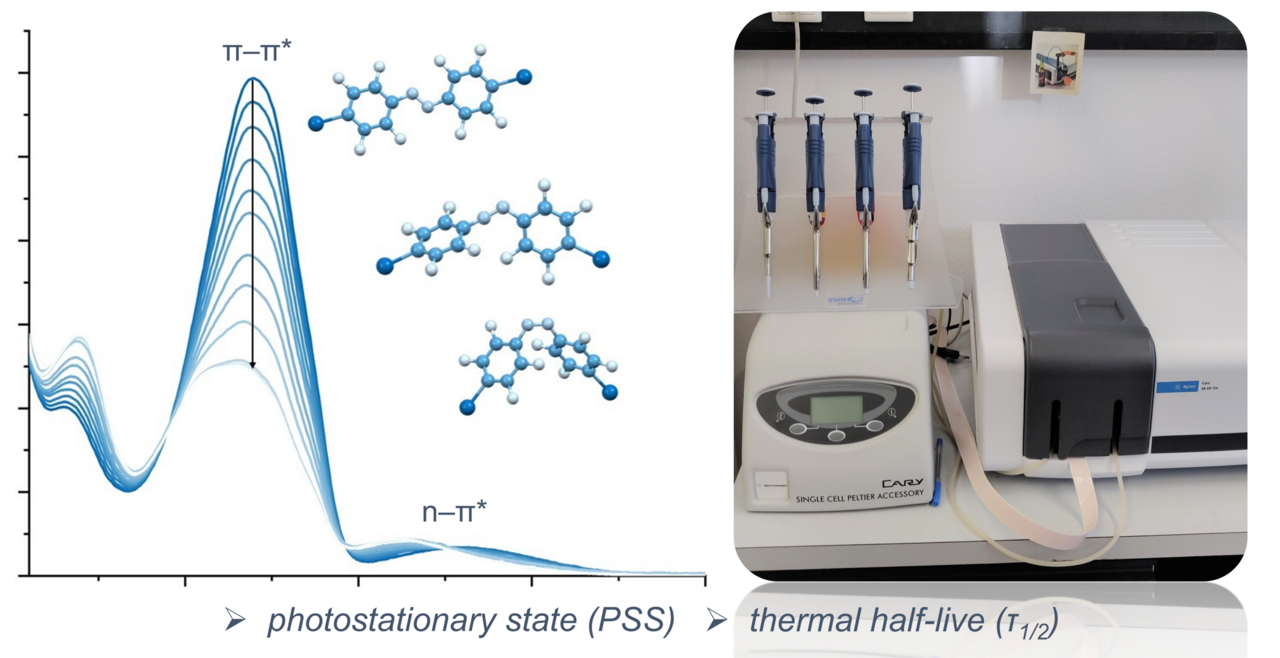
Photochemistry of organic compounds: Research projects involve the synthesis and characterisation of photoresponsive molecules that undergo controlled changes in geometry or function upon light irradiation. These processes are investigated using UV–Vis spectroscopy and complementary analytical methods.

Modern fluoroorganic chemistry: Students are introduced to the synthesis and characterisation of fluoroorganic compounds, with particular attention to their unique reactivity and properties. 19F-NMR spectroscopy plays a central role in the analysis of these systems.

Computational chemistry: We provide training in molecular modelling and introductory molecular dynamics simulations. Basic quantum chemical calculations (Gaussian) are routinely performed on the high-performance computing cluster of the Zentrum für Informations- und Medientechnologie (ZIM), enabling close integration of experimental and computational approaches.


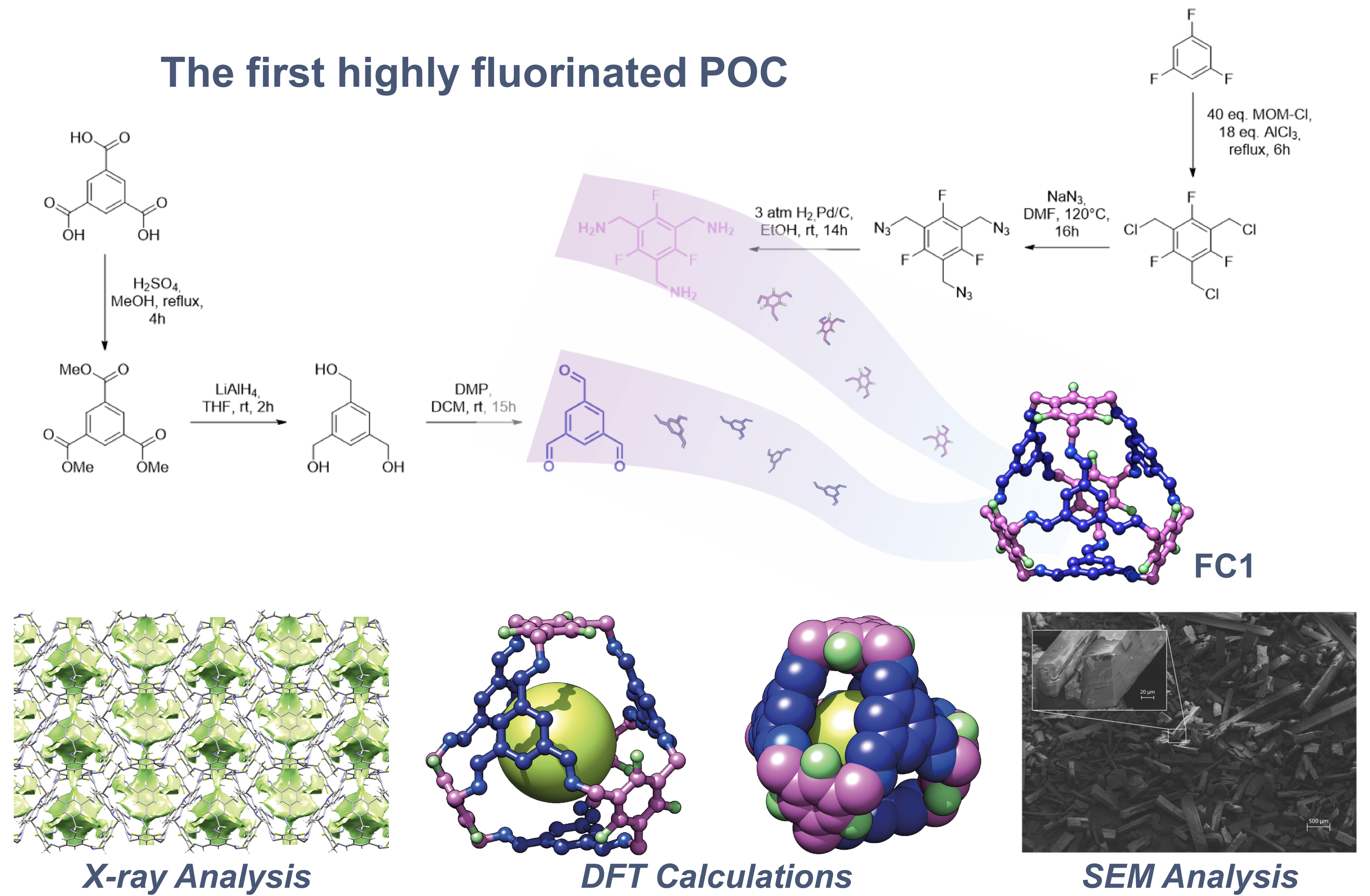
Fluorinated Organic Cage Compounds

We design and synthesise well-defined molecular building blocks and investigate their self-assembly into discrete cage and macrocycles. Particular emphasis is placed on understanding how molecular structure, symmetry, and non-covalent interactions govern cage formation, stability, and dynamics. Once assembled, these cage-like compounds are systematically studied with respect to their structural, spectroscopic, and physicochemical properties, including guest binding, responsiveness to external stimuli, and functional behaviour in solution and, where relevant, in the solid-state by means of gas sorption or uptake of volatile or persistent organic compounds, in addition to powder X-ray analysis and single-crystal X-ray analysis, depending on each system.

Chem. Sci. 2025, 16, 13221-13228 Link

Chem. Commun. 2024, 60, 14762-14765 Link

Angew. Chem. Int. Ed. 2024, 63, e202418877 Link

Angew. Chem. Int. Ed. 2024, 63, e202318362 Link

Chem. Commun. 2022, 58, 5233-5236 Link

Chem. Commun. 2020, 56, 4761-4764 Link


Photochemistry

To achieve external control over function or even the assembly and disassembly of supramolecular structures, we incorporate photoswitchable molecular units into our systems. These photoresponsive components are synthesised in-house and integrated into our supramolecular assemblies. Their photochemical behaviour is investigated using our own UV–Vis spectrophotometer, allowing precise correlation between molecular structure, light-induced switching, and supramolecular response. A particular current focus lies on photoswitchable systems that operate in conjunction with halogen bonding, enabling the modulation of directional non-covalent interactions by light and providing access to dynamic, stimuli-responsive supramolecular materials.

Chem. Eur. J. 2025, 31, e202501047 Link

Angew. Chem. Int. Ed. 2022, 61, e202212745 Link 

Beilstein J. Org. Chem. 2019, 15, 2013-2019 Link

Chem. Commun. 2019, 55, 8768-8771 Link


X-Ray Analysis

We rely heavily on single-crystal X-ray analysis in our group to visualize obtained structures and to obtain additional information about obtained compounds in the solid state.